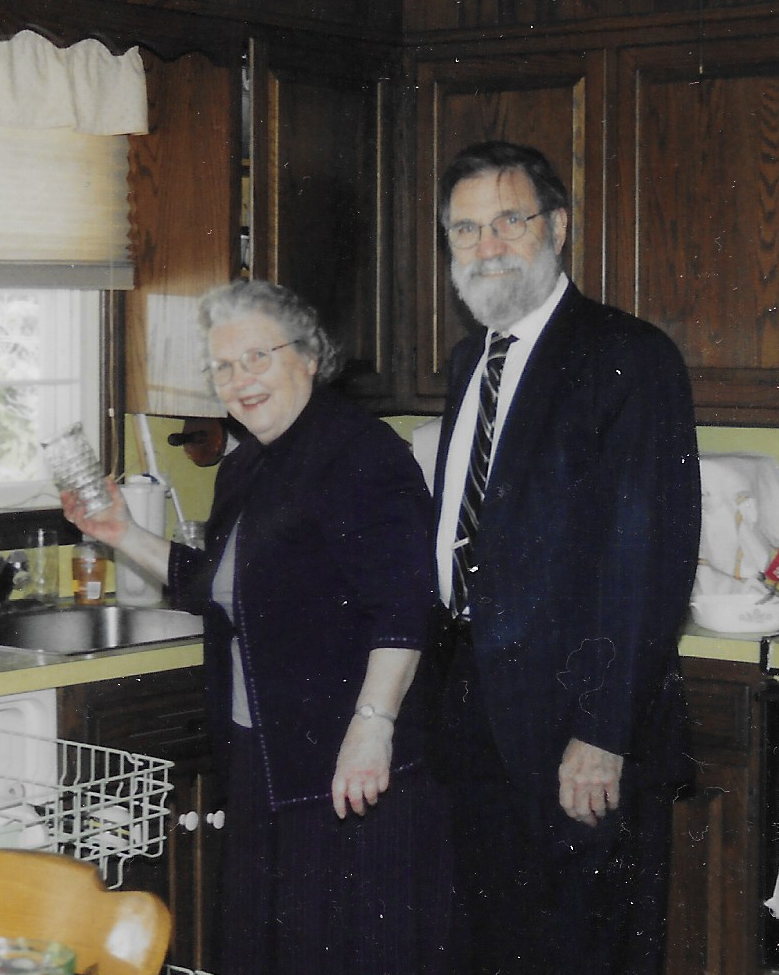
Allan was the first patient at the Lancaster Cleft Palate Clinic in 1938. According to his daughter, Dr. Cooper was looking for patients who could benefit from speech therapy and Allan’s father signed him up. At the time, his speech was not understood by others and they assumed his was slow. Which was not at all the case. His cleft palate make it challenging for Allan to communicate.
This is Allan’s story according to his daughter, Margaret. Margaret says that her dad would not have accomplished all he did without Dr. Cooper and the Clinic. “We are here (all his kids and grandkids) because of Dr. Cooper.”
Dad was born in 1925, the fourth of what would become eight children. Parents are always concerned about having a healthy baby. Dad was healthy, but he had a life-changing difference – two, in fact. He had a double cleft in his lip and a cleft palate. The lip was repaired but left him with a misshaped upper lip and some scars. He was terribly self-conscious about the scars. Which is why he always had a full beard and mustache.
But, more important than the cleft lip was the hole in his mouth. He didn’t have a hard or soft palate – which are needed for a whole lot of things, and all he had was a hole. Grandma couldn’t breastfeed him because he couldn’t suck…there was no way to stop the airflow at the back of his mouth. So, grandma fed him with a medicine dropper. As he grew and began to talk, he had a miserable time. The tongue is used to form letters. Only his mother, and sisters, could understand what he was saying. His father didn’t have any idea what he was saying and got frustrated quickly. So, instead of joining Grandpa in his work shop, to learn the wood working skills needed for Grandpa’s business as a cabinet and pattern maker, Dad was in the kitchen with his mother and sisters, learning to cook and bake pies and cookies.
School was terribly frustrating for Dad. His teachers knew he was intelligent and he had good grades on homework and tests, but not one of them knew what he was saying.
During this time there was an orthodontist in Lancaster city, named Dr. Herbert Cooper. He knew there were many children like my dad and he vowed to find a way to help them. He worked out how he could do it and he finally had a prototype – all he needed was a patient. They had a speech therapist in his office named Jenny Diller, and he asked her if she knew of any children whose parents would allow him to try his invention on their child. She didn’t, but her husband was a teacher at the school Dad went to and he thought of Dad right away. He gave Dad’s name to the clinic and my grandparents were contacted. They decided to listen to what Dr. Cooper had to say. When he first mentioned that he had a new way to treat the cleft palate, my grandfather refused to allow any more surgery on his son [as past surgeries had only made the situation worse]. Dr. Cooper assured him there was no surgery involved and proceeded to explain his idea to form an artificial roof with a hard and soft part that would fit into dad’s mouth and hook onto his teeth. He explained how they would make a mold of his mouth and then make the palate from the mold. Then, he was talking Grandpa’s language. Grandpa knew all about molds and patterns and they agreed to let Dr. Cooper help their son.
Dad was 12 when he started with Dr. Cooper. Those of you who’ve had braces remember having impressions made of your teeth – this was similar but because it was 1938 and the technology was a bit different than today. To make the mold, they put something like plaster of Paris in his mouth. I don’t know exactly what or how they did it but the stuff took a while to set. Dad had to keep it in his mouth the whole way home. He was riding a city bus, or a trolley, I’m not sure which, by himself, for the 6-8 miles home from Lancaster to Bareville. He said it was miserable. He was afraid he was going to throw up but he knew that if he did, he’d just have to start over.
When he got home the stuff was set enough for Grandpa to take it out and they had the first model of Dad’s mouth for the first appliance that Dr. Cooper would make. The appliance was successful and dad started to learn to talk. He said he never realized why no one could understand him. To him he sounded like everyone else.
He started speech therapy with Jenny Diller and she worked with him for a long time. Not only couldn’t talk, he couldn’t blow his nose or blow up a balloon or suck on a straw. One of the exercises he was given was learning how to breathe through his nose. They put a wooden stick in his mouth, like a tongue depressor the doctor uses. Then a Cheerio was put on the stick and he was supposed to move the Cheerio by blowing air through his nose.
His treatments lasted almost a lifetime. As he grew he needed a larger appliance, or the teeth clasps wore out or the teeth wore down from the clasps.
All the therapy made such a difference in his life that by the time he was a senior in high school his class nominated him to be their graduation speaker. Dr. Cooper was thrilled.
Over the years dad was asked to go to the Clinic and talk to parents of prospective new patients. To show them what a difference the artificial palate and speech therapy treatments made in his life.
Dr. Cooper also took dad with him when he went to meetings to talk about the Cleft Palate Clinic, or to ask for donations. Dad was exhibit #1! Dr. Cooper would talk about his work and Dad would get up and talk a little bit. Then Dr. Cooper would have Dad take out his appliance and have him say the same thing again without the appliance. The difference was astounding.
Without Dr. Cooper and Jenny Diller, Dad would never have become the self-confident self-assured man he was. He got married to a career woman who worked as a nurse while he got his own business up and going. They had 6 children, all of whom have had careers; 13 grandchildren, etc. One of the first questions he asked as each child was born, was about their mouth. He was so thankful that none of us have any clefts in our mouths. There was one thing he never did – he never spoke to any of us children without his appliance being in his mouth.
So, thank you Dr. Cooper and Jenny Diller and the staff for being merciful to the Steffy’s. My oldest brother is named Herbert, after Dr. Cooper. The clinic continues to grow and treat craniofacial differences – either from birth or injury. They continue to be merciful to all who come to them for treatment, because, everyone is treated, regardless of their ability to pay.
Words from Allan: Coming to the Clinic always felt like coming home. You made me feel as welcome as family.